Buy powerofwords.eu ?
We are moving the project
powerofwords.eu .
Are you interested in purchasing the domain
powerofwords.eu ?
domain@kv-gmbh.de · 0541-91531010
Buy powerofwords.eu ?
What is communication in psychology?
Communication in psychology refers to the process of exchanging information, thoughts, and feelings between individuals. It involves both verbal and nonverbal cues, such as body language, facial expressions, and tone of voice. Effective communication is essential for building relationships, resolving conflicts, and understanding others' emotions and perspectives. In psychology, communication plays a crucial role in therapy, counseling, and research to help individuals express themselves and connect with others. **
Can you make a documentary about the psychology of people, money, ambition, success, and business?
Yes, a documentary about the psychology of people, money, ambition, success, and business could be made by exploring the various psychological factors that drive individuals in their pursuit of wealth, success, and achievement. The documentary could delve into the impact of money on people's behavior, the psychological drivers of ambition and success, and the mental health implications of the high-pressure business world. By interviewing experts in psychology, business, and finance, as well as individuals with personal experiences in these areas, the documentary could provide valuable insights into the complex interplay between psychology and these aspects of life. **

Similar search terms for The-Psychology-Of-Money
Top-Angebote
Products related to The-Psychology-Of-Money:
-
Harriman House Atomic Habits, The Compound Effect, The Psychology of Money 3 Books Collection SetAtomic Habits People think that when you want to change your life, you need to think big. But world-renowned habits expert James Clear has discovered another way. He knows that real change comes from the compound effect of hundreds of small decisions: doing two push-ups a day, waking up five minutes early, or holding a single short phone call. The Compound Effect As the central curator of the success media industry for over 25 years, author Darren Hardy has heard it all, seen it all, and tried most of it. This book reveals the core principles that drive success. The Compound Effect contains the essence of what every superachiever needs to know, practice, and master to obtain extraordinary success. Inside you will find strategies on: How to win--every time! The Psychology of Money Doing well with money isn't necessarily about what you know. It's about how you behave. And behavior is hard to teach, even to really smart people. Money investing, personal finance, and business decisions is typically taught as a math-based field, where data and formulas tell us exactly what to do. But in the real world people don't make financial decisions on a spreadsheet.22,95 £*Shipping: 2,99 £Secure redirect to the provider

-
What is the purpose and significance of hidden questions in psychology and communication?
Hidden questions in psychology and communication serve the purpose of uncovering underlying thoughts, feelings, and motivations that may not be readily apparent. By asking indirect or subtle questions, psychologists and communicators can gain insight into a person's true beliefs and emotions, which can be valuable for understanding their behavior and providing effective support or guidance. Hidden questions also allow individuals to express themselves more freely, as they may feel less defensive or guarded when responding to a question that is not directly confronting their inner thoughts. Overall, hidden questions play a significant role in deepening understanding and facilitating meaningful communication in both psychological and interpersonal contexts. **
-
Can someone interpret body language, psychology?
Yes, someone can interpret body language and psychology through observation and analysis. Body language can provide valuable insights into a person's emotions, intentions, and thoughts. By observing nonverbal cues such as facial expressions, gestures, and posture, and applying knowledge of psychological principles, one can make educated interpretations about a person's mental and emotional state. However, it's important to remember that interpretations of body language and psychology are not always definitive and can vary based on individual differences and cultural influences. **
-
What is the psychology of perception?
The psychology of perception is the study of how we interpret and make sense of sensory information from the environment. It involves understanding how our brain processes and organizes this information to create our perception of the world around us. Factors such as past experiences, expectations, and emotions can influence how we perceive and interpret sensory stimuli. Researchers in this field aim to uncover the underlying mechanisms that shape our perception and how it can vary among individuals. **
-
What is the psychology of guilt?
Guilt is a complex emotion that arises when an individual believes they have done something wrong or violated their own moral code. It can lead to feelings of remorse, self-blame, and a desire to make amends for the perceived wrongdoing. The psychology of guilt involves understanding the cognitive processes, emotional responses, and behavioral tendencies associated with this emotion, as well as exploring how guilt can impact an individual's mental health and relationships. Therapeutic interventions such as cognitive-behavioral therapy can help individuals address and cope with feelings of guilt in a healthy and constructive manner. **
What are the limits of psychology?
The limits of psychology are primarily related to the complexity and variability of human behavior and mental processes. While psychology can provide valuable insights into human behavior, it cannot always predict or control individual actions with complete accuracy. Additionally, ethical considerations and the need for informed consent place limits on the types of research and interventions that psychologists can undertake. Finally, the field of psychology is constantly evolving, and there are still many unanswered questions about the human mind and behavior. **
Is the study of psychology difficult?
The difficulty of studying psychology can vary depending on the individual and their interests and strengths. Some people may find certain aspects of psychology challenging, such as understanding complex theories or statistical analysis, while others may find it easier to grasp concepts related to human behavior and mental processes. Overall, the study of psychology requires critical thinking, research skills, and an understanding of scientific methods, which can be challenging for some students. However, with dedication and interest in the subject, many people find the study of psychology to be rewarding and intellectually stimulating. **
Top-Angebote
Products related to The-Psychology-Of-Money:
-
Harriman House Psychology of Money, The Trading Game and Money: A Story of Humanity 3 Books Collection SetPsychology of Money by Morgan Housel Doing well with money isn't necessarily about what you know. It's about how you behave. And behavior is hard to teach, even to really smart people. Money – investing, personal finance, and business decisions – is typically taught as a math-based field, where data and formulas tell us exactly what to do. But in the real world people don't make financial decisions on a spreadsheet. They make them at the dinner table, or in a meeting room, where personal history, your own unique view of the world, ego, pride, marketing, and odd incentives are scrambled together. The Trading Game by Gary Stevenson Ever since he was a kid, kicking broken footballs on the streets of East London in the shadow of Canary Wharf's skyscrapers, Gary wanted something better. Something a whole lot bigger. Then he won a competition run by a bank: 'The Trading Game'. The prize: a golden ticket to a new life, as the youngest trader in the whole city. A place where you could make more money than you'd ever imagined. Where your colleagues are dysfunctional maths geniuses, overfed public schoolboys and borderline psychopaths, yet they start to feel like family. Where soon you're the bank's most profitable trader, dealing in nearly a trillion dollars. A day. Where you dream of numbers in your sleep - and then stop sleeping at all. Money: A Story of Humanity by David McWilliams MONEY. The object of our desires. The engine of our genius. Humanity’s greatest invention. From clay tablets in Mesopotamia to today’s cryptocurrency, global economist David McWilliams takes us on an epic journey of innovation, disruption and transformation that is an astonishing new history of our species. The question is, over 5,000 years, have we changed money – or has money changed us?22,99 £*Shipping: 2,99 £Secure redirect to the provider
-
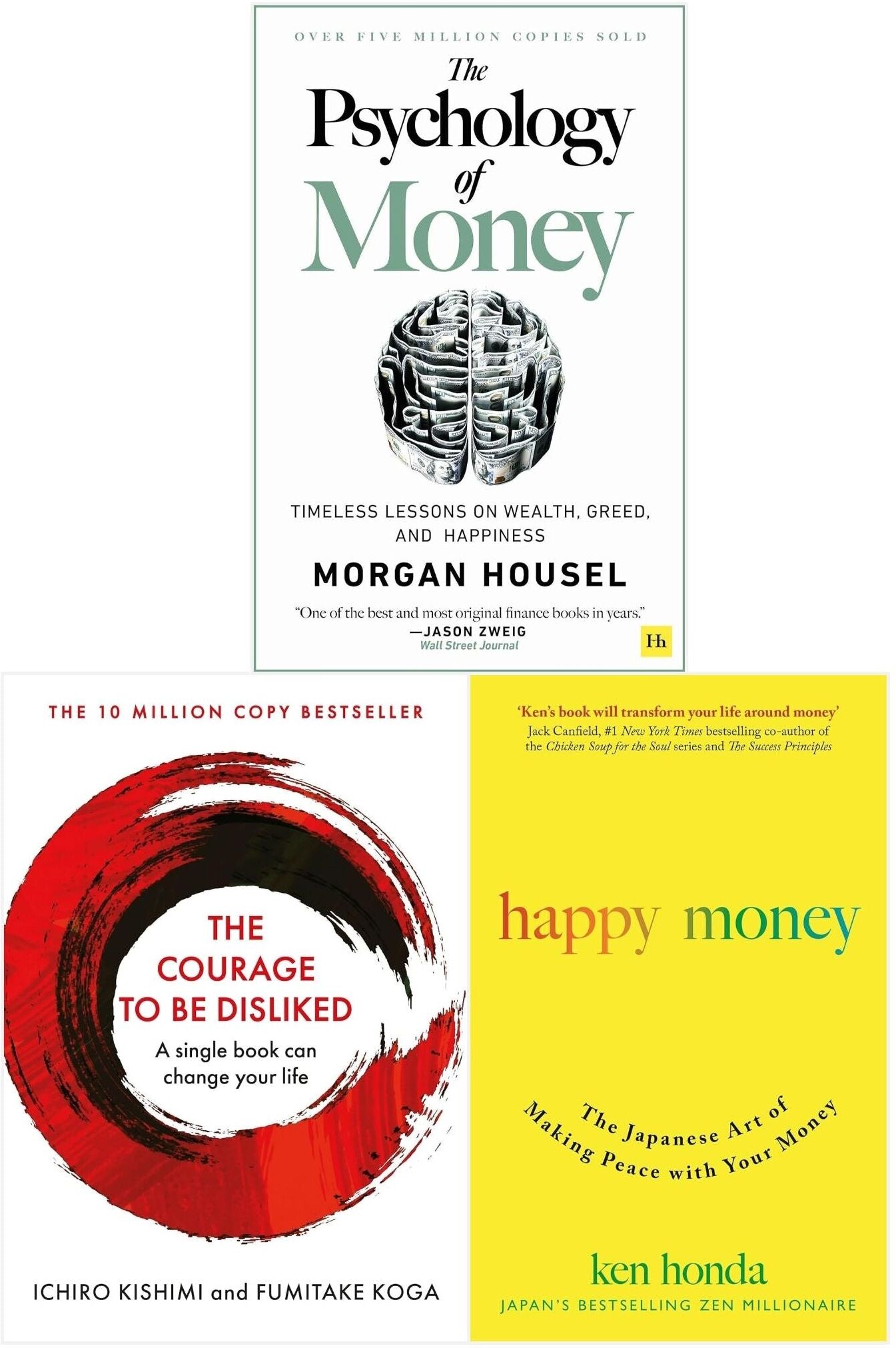
John Murray Happy Money, The Courage to be Disliked and Psychology of Money 3 Books Collection SetHappy Money Look around you - what do you see? You may discover to your surprise that the people who are most at peace with money are the ones who walk nimbly between having too little and having too much. They have found a balance between indulgence and austerity; between success and happiness; between motivation and inspiration; and between any number of other poles we tend to think of as either/or choices, but which in reality are simply posts on either side of a doorway through which we must pass. The Courage to be Disliked Stop people-pleasing and achieve true happiness. Millions have already benefited from the wisdom dispensed in The Courage to Be Disliked, its simple yet profound advice showing us how to harness our inner power to become the person we would like to be. A philosopher and a student have a discussion. Their conversation reveals a profoundly liberating way of thinking: by developing the courage to change, set healthy boundaries and resist the impulse to please others, it is possible to find genuine and lasting happiness. The Psychology of Money Doing well with money isn't necessarily about what you know. It's about how you behave. And behavior is hard to teach, even to really smart people. Money investing, personal finance, and business decisions is typically taught as a math-based field, where data and formulas tell us exactly what to do. But in the real world people don't make financial decisions on a spreadsheet. They make them at the dinner table, or in a meeting room, where personal history, your own unique view of the world, ego, pride, marketing, and odd incentives are scrambled together. In The Psychology of Money, award-winning author Morgan Housel shares 19 short stories exploring the strange ways people think about money and teaches you how to make better sense of one of life's most important topics.19,99 £*Shipping: 2,99 £Secure redirect to the provider
-
Harriman House Atomic Habits, The Compound Effect, The Psychology of Money 3 Books Collection SetAtomic Habits People think that when you want to change your life, you need to think big. But world-renowned habits expert James Clear has discovered another way. He knows that real change comes from the compound effect of hundreds of small decisions: doing two push-ups a day, waking up five minutes early, or holding a single short phone call. The Compound Effect As the central curator of the success media industry for over 25 years, author Darren Hardy has heard it all, seen it all, and tried most of it. This book reveals the core principles that drive success. The Compound Effect contains the essence of what every superachiever needs to know, practice, and master to obtain extraordinary success. Inside you will find strategies on: How to win--every time! The Psychology of Money Doing well with money isn't necessarily about what you know. It's about how you behave. And behavior is hard to teach, even to really smart people. Money investing, personal finance, and business decisions is typically taught as a math-based field, where data and formulas tell us exactly what to do. But in the real world people don't make financial decisions on a spreadsheet.22,95 £*Shipping: 2,99 £Secure redirect to the provider
-
What is communication in psychology?
Communication in psychology refers to the process of exchanging information, thoughts, and feelings between individuals. It involves both verbal and nonverbal cues, such as body language, facial expressions, and tone of voice. Effective communication is essential for building relationships, resolving conflicts, and understanding others' emotions and perspectives. In psychology, communication plays a crucial role in therapy, counseling, and research to help individuals express themselves and connect with others. **
-
Can you make a documentary about the psychology of people, money, ambition, success, and business?
Yes, a documentary about the psychology of people, money, ambition, success, and business could be made by exploring the various psychological factors that drive individuals in their pursuit of wealth, success, and achievement. The documentary could delve into the impact of money on people's behavior, the psychological drivers of ambition and success, and the mental health implications of the high-pressure business world. By interviewing experts in psychology, business, and finance, as well as individuals with personal experiences in these areas, the documentary could provide valuable insights into the complex interplay between psychology and these aspects of life. **
-
What is the purpose and significance of hidden questions in psychology and communication?
Hidden questions in psychology and communication serve the purpose of uncovering underlying thoughts, feelings, and motivations that may not be readily apparent. By asking indirect or subtle questions, psychologists and communicators can gain insight into a person's true beliefs and emotions, which can be valuable for understanding their behavior and providing effective support or guidance. Hidden questions also allow individuals to express themselves more freely, as they may feel less defensive or guarded when responding to a question that is not directly confronting their inner thoughts. Overall, hidden questions play a significant role in deepening understanding and facilitating meaningful communication in both psychological and interpersonal contexts. **
-
Can someone interpret body language, psychology?
Yes, someone can interpret body language and psychology through observation and analysis. Body language can provide valuable insights into a person's emotions, intentions, and thoughts. By observing nonverbal cues such as facial expressions, gestures, and posture, and applying knowledge of psychological principles, one can make educated interpretations about a person's mental and emotional state. However, it's important to remember that interpretations of body language and psychology are not always definitive and can vary based on individual differences and cultural influences. **
Similar search terms for The-Psychology-Of-Money
-
What is the psychology of perception?
The psychology of perception is the study of how we interpret and make sense of sensory information from the environment. It involves understanding how our brain processes and organizes this information to create our perception of the world around us. Factors such as past experiences, expectations, and emotions can influence how we perceive and interpret sensory stimuli. Researchers in this field aim to uncover the underlying mechanisms that shape our perception and how it can vary among individuals. **
-
What is the psychology of guilt?
Guilt is a complex emotion that arises when an individual believes they have done something wrong or violated their own moral code. It can lead to feelings of remorse, self-blame, and a desire to make amends for the perceived wrongdoing. The psychology of guilt involves understanding the cognitive processes, emotional responses, and behavioral tendencies associated with this emotion, as well as exploring how guilt can impact an individual's mental health and relationships. Therapeutic interventions such as cognitive-behavioral therapy can help individuals address and cope with feelings of guilt in a healthy and constructive manner. **
-
What are the limits of psychology?
The limits of psychology are primarily related to the complexity and variability of human behavior and mental processes. While psychology can provide valuable insights into human behavior, it cannot always predict or control individual actions with complete accuracy. Additionally, ethical considerations and the need for informed consent place limits on the types of research and interventions that psychologists can undertake. Finally, the field of psychology is constantly evolving, and there are still many unanswered questions about the human mind and behavior. **
-
Is the study of psychology difficult?
The difficulty of studying psychology can vary depending on the individual and their interests and strengths. Some people may find certain aspects of psychology challenging, such as understanding complex theories or statistical analysis, while others may find it easier to grasp concepts related to human behavior and mental processes. Overall, the study of psychology requires critical thinking, research skills, and an understanding of scientific methods, which can be challenging for some students. However, with dedication and interest in the subject, many people find the study of psychology to be rewarding and intellectually stimulating. **
* All prices are inclusive of VAT and, if applicable, plus shipping costs. The offer information is based on the details provided by the respective shop and is updated through automated processes. Real-time updates do not occur, so deviations can occur in individual cases. ** Note: Parts of this content were created by AI.